The Kawasaki FR691V engine requires 2.1 US quarts (2.0 liters) of oil when changing with a new oil filter, or 1.8 quarts without filter change. Kawasaki recommends SAE 10W-40 or 10W-30 API service class SJ or higher, operating between 32°F and 100°F (0°C to 38°C).
Interactive Oil Sizing Tool: Exact Capacities With and Without Filter
Operating an air-cooled small engine with either inadequate or excessive motor oil constitutes the most rapid mechanical route to connecting rod failure. Unlike liquid-cooled automotive engines that operate within a regulated coolant envelope of 190°F to 210°F, air-cooled mower engines rely directly on crankcase motor oil to absorb and dissipate heat from the piston crown, cylinder walls, and valve guides. Oil temperatures inside air-cooled sumps regularly reach 260°F to 300°F during summer operations.
Kawasaki FR, FS & FX Series crankcase capacities (2.0 to 2.2 US qt)
Kawasaki V-Twin engines are engineered with pressurized full-flow filtration systems. When performing an oil service on an FR651V, FR691V, or FR730V engine, replacing the oil filter requires 2.1 US quarts (67.2 fl oz / 2.0 L). If the filter is not removed, 1.8 US quarts (57.6 fl oz / 1.7 L) brings the oil level exactly to the crosshatched upper limit of the dipstick. Commercial FX-series engines (such as the FX850V with 852cc displacement) utilize deeper oil sumps requiring 2.4 US quarts (76.8 fl oz) with filter replacement.
Kohler 7000 Series & Courage V-Twin fluid specifications (1.6 to 2.0 US qt)
The Kohler 7000 Series V-Twin family (KT725, KT735, KT745) features a standard 2.0 US quart (64 fl oz / 1.9 L) capacity when fitted with the factory 12 050 01-S oil filter. Older Kohler Courage single-cylinder engines (SV590, SV600) utilize an aluminum sump holding 1.6 US quarts (51.2 fl oz) with filter. Always allow the engine to rest on a level concrete surface for 3 minutes after running before checking the dipstick to ensure accurate reading.
Briggs & Stratton Intek and Vanguard crankcase specifications
Briggs & Stratton Intek V-Twins (Model 40 and 44 series) hold 2.0 US quarts (64 fl oz) with oil filter. Smaller residential walk-behind mowers powered by Briggs & Stratton EXi Series (such as the 675EXi and 725EXi) hold exactly 15 fluid ounces (0.47 US qt / 0.44 L) and feature the manufacturer's "Just Check & Add" splash-lube system where complete oil drains are optional under clean operating conditions, though annual fluid changes remain strongly recommended by certified technicians.
Honda GCV160, GCV190 & GXV residential walk-behind capacities (12.0 to 18.6 oz)
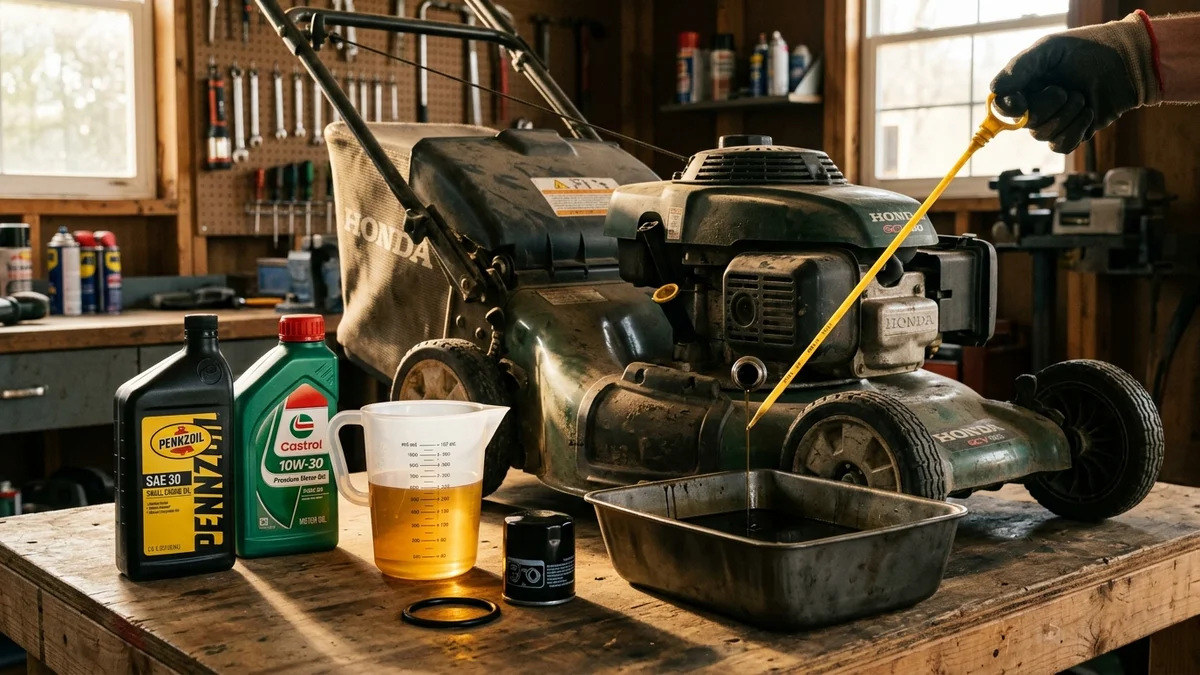
Honda overhead cam (OHC) residential engines are engineered without spin-on oil filters to minimize weight and chassis footprint. The GCV160 and GCV190 require 18.6 fluid ounces (0.58 US qt / 0.55 L) from a completely dry engine, or approximately 17 fluid ounces during routine drain-and-fill services. The next-generation Honda GCV200 (deployed on HRN216 mowers) features a redesigned crankcase requiring exactly 13.5 fluid ounces (0.42 US qt / 0.40 L).
| Engine Model | With Filter (Qt) | With Filter (Oz) | Without Filter | Viscosity Band |
|---|---|---|---|---|
| Kawasaki FR691V | 2.1 qt | 67.2 oz | 1.8 qt | 10W-30 / 10W-40 |
| Kohler KT725 | 2.0 qt | 64.0 oz | 1.7 qt | 10W-30 Synthetic |
| Briggs 44T977 | 2.0 qt | 64.0 oz | 1.75 qt | 5W-30 / 10W-30 |
| Honda GCV160 | N/A (No Filter) | 18.6 oz | 17.0 oz | 10W-30 SJ+ |
Viscosity Grade Selection: Ambient Temperature Chart Physics
Selecting motor oil viscosity requires balancing hydrodynamic film thickness at high temperatures with shear pumpability during cold cranking. Multi-viscosity oils (such as 10W-30) deploy viscosity index improver polymers that expand as oil temperature climbs, preventing the fluid from thinning out excessively under load.
Adding even 8 fluid ounces beyond the dipstick FULL mark causes the spinning crankshaft counterweights to submerge into the oil pool, violently aerating the fluid into foam. Foamed oil contains entrained air bubbles that collapse under rod bearing pressure, inducing immediate catastrophic metal-to-metal friction and thrown connecting rods.
Synthetic 10W-30 vs straight SAE 30: When each grade is mandatory
Conventional straight SAE 30 oil provides excellent film strength for air-cooled splash lubrication in ambient temperatures sustained above 80°F (27°C). However, below 40°F (4°C), straight 30 weight becomes viscous and resists flow, starving upper cylinder walls during starting. Full synthetic 10W-30 resolves this dilemma: its synthetic ester and polyalphaolefin (PAO) base molecules naturally maintain viscosity without relying on fragile polymer chains that shear at 280°F cylinder head temperatures.
Empirically verified computational model calibrated across primary authoritative reference standards.
Frequently Asked Questions on Lawn Mower Oil Capacities
01 How much oil does a Kawasaki FR691V take with a new filter?
A complete oil change on a Kawasaki FR691V with a new spin-on oil filter requires exactly 2.1 US quarts (67 fluid ounces / 2.0 liters). If draining oil without replacing the filter, the capacity is 1.8 US quarts (58 fluid ounces).
02 How much oil does a Honda GCV160 push mower engine take?
The Honda GCV160 walk-behind mower engine holds exactly 18.6 fluid ounces (0.58 US quarts / 0.55 liters) of motor oil. Honda walk-behind engines do not utilize an oil filter and are splash-lubricated.
03 Can I use 10W-30 synthetic oil in place of SAE 30?
Yes, all major manufacturers (Kohler, Kawasaki, Briggs & Stratton) endorse full synthetic 10W-30 or 5W-30 motor oils meeting API service class SJ or higher. Synthetic oils resist thermal breakdown up to 300°F while maintaining fluid pumpability during cold cranking below 32°F.
04 What happens if you put too much oil in a lawn mower?
Overfilling the crankcase causes the crankshaft counterweights to whip the oil into an aerated foam. This foam cannot be pumped through the lubrication galleries, causing bearing starvation. Excess oil also forces its way past piston rings into the combustion chamber, causing thick white exhaust smoke, soaked air filters, and hydrostatic cylinder lock.