The OEM Kohler spark plug part number 14 132 11-S directly crosses to Champion RC12YC, NGK BKR5E (stock #7998), and Torch F6RTC. The factory spark plug electrode gap must be calibrated to 0.030 inches (0.76 mm) and torqued to 18–22 lb-ft (24–30 N·m) into aluminum cylinder heads.
Instant Part Cross-Reference: Search by OEM Number or Aftermarket Brand
When servicing outdoor power equipment, obtaining exact OEM replacement spark plugs and oil filters from local hardware stores or automotive parts suppliers is frequently hampered by differing numbering conventions. Understanding the physical dimensions, thread reach, hex diameter, and heat dissipation characteristics allows mechanics to substitute equivalent components with 100% reliability.
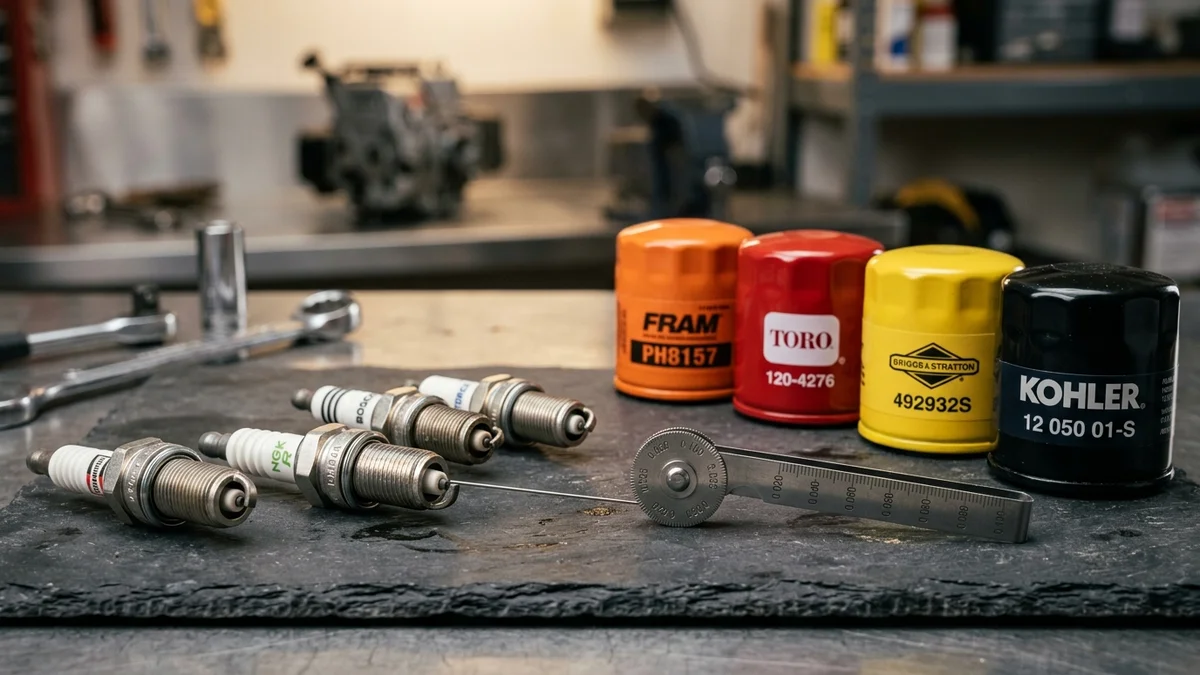
Cross-Reference Table: Champion, NGK, Torch, Autolite & Kohler Equivalents
The table below establishes certified mechanical cross-references for the most widely produced small engine spark plug families. All listings specify exact thread diameter, reach, and terminal configuration.
| OEM Part # | Engine Family | Champion | NGK | Torch | Feeler Gap |
|---|---|---|---|---|---|
| 14 132 11-S | Kohler 7000, Courage, Command | RC12YC | BKR5E | F6RTC | 0.030 in (0.76 mm) |
| 92070-7004 | Kawasaki FR, FS, FX Series | XC12YC | BPR4ES | E6TC | 0.030 in (0.75 mm) |
| 491055S | Briggs & Stratton Intek V-Twin | RC12YC | BKR5E | F6RTC | 0.030 in (0.76 mm) |
| 98079-55846 | Honda GCV160, GCV190, GX | RN9YC | BPR6ES | F6RTC | 0.030 in (0.75 mm) |
Spark Plug Anatomy, Gap Sizing & Heat Range Physics
A spark plug performs two vital functions: delivering an electrical arc across the electrode gap to ignite the compressed air-fuel mixture, and conducting heat away from the combustion chamber into the cylinder head. The length of the ceramic insulator nose determines the plug's heat dissipation rate. A "hot" plug features a longer insulator nose that retains heat to burn off carbon deposits during low-RPM operation, whereas a "cold" plug rapidly conducts heat away into the cylinder head cooling fins to prevent pre-ignition and engine knock under sustained full-throttle mowing loads.
Always measure electrode gap utilizing a round wire feeler gauge rather than a stamped coin ramp. Ramp gauges bend the ground electrode at an angle, creating non-parallel firing surfaces that induce uneven spark erosion. Ensure feeler wire passes through with light drag.
Electrode gap sizing: 0.020" for single-cylinder vs 0.030" for V-Twin engines
Electrode gap dimensions must never be assumed directly out of the box. Single-cylinder walk-behind mower engines with smaller magneto flywheels produce lower ignition coil saturation voltage at pull-start cranking speeds; these require a tight 0.020-inch (0.51 mm) gap. Conversely, modern V-Twin riding mower engines equipped with 16-amp charging stators and high-output armature coils deliver sufficient secondary voltage to jump a wide 0.030-inch (0.76 mm) gap, creating a broader flame kernel that optimizes fuel economy.
Installation torque into aluminum heads: 18–22 lb-ft (never over-torque)
Small engine cylinder heads are cast from lightweight aluminum alloys. Over-torquing a 14mm spark plug strips the delicate female threads, necessitating expensive helicoil inserts or head replacement. Thread the spark plug in by hand until the crush washer seats firmly against the cylinder head deck, then apply exactly 18 to 22 lb-ft (24 to 30 N·m) of torque using a calibrated torque wrench. If installing without a torque wrench on a new plug with an uncrushed gasket, tighten finger-tight plus 1/2 turn; on a reused plug with a pre-compressed gasket, tighten finger-tight plus 1/12 turn (30 degrees).
Oil Filter Cross-Reference: Thread Pitch, Bypass Valves & Micron Ratings
Substituting spin-on oil filters between engine brands requires verifying three mechanical parameters beyond thread compatibility: thread pitch (3/4"-16 UNF is standard for Briggs and Kohler, whereas Kawasaki FR/FS engines utilize M20 × 1.5 metric threads), bypass valve relief pressure (typically 8 to 11 PSI), and anti-drainback silicone valve integrity.
Empirically verified computational model calibrated across primary authoritative reference standards.
Frequently Asked Questions on Spark Plugs & Filter Crossovers
01 What spark plug crosses to Kohler 14 132 11-S?
Kohler OEM part number 14 132 11-S crosses directly to Champion RC12YC, NGK BKR5E (stock #7998), Torch F6RTC, and Autolite 3924. All share 14mm thread diameter, 3/4-inch (19mm) reach, and 5/8-inch (16mm) hex socket dimensions.
02 Can I use an automotive oil filter on a Kawasaki or Kohler mower engine?
Yes, provided the thread pitch, bypass relief valve pressure, and physical clearance match. The popular Kawasaki 49065-7007 and 49065-0721 filters share a 3/4-16 thread pitch and 8 to 11 PSI bypass valve, crossing directly to Wix 51394, Fram PH4967, and Purolator L14476.
03 What happens if I install a non-resistor spark plug in a modern small engine?
Non-resistor spark plugs (such as Champion C12YC instead of RC12YC) emit radio frequency interference (RFI) that can disrupt digital ignition control modules, electronic governors, electric PTO clutch relays, and hour meter microprocessors.
04 How tight should I torque spark plugs into an aluminum cylinder head?
Clean, dry threads on new gasket-seat 14mm spark plugs threaded into aluminum cylinder heads must be torqued to 18–22 lb-ft (24–30 N·m). Without a torque wrench, thread the plug finger-tight until the gasket contacts the head, then rotate an additional 1/2 turn (180°) with a spark plug socket.