To determine the precise amount of two-stroke oil needed for any volume of gasoline, divide total fuel volume in fluid ounces (Gallons × 128) by the designated engine ratio. For a standard 50:1 ratio with 2.5 gallons of gasoline: (2.5 × 128) ÷ 50 = 6.40 fluid ounces (189.3 mL). For a 40:1 ratio: (2.5 × 128) ÷ 40 = 8.00 fluid ounces (236.6 mL).
Why Two-Stroke Engines Require Pre-Mixed Fuel
Unlike four-stroke engines that feature an isolated crankcase oil sump and pressurized oil pump, two-stroke small engines (commonly found on string trimmers, blowers, chainsaws, and vintage Lawn-Boy push mowers) rely on the incoming fuel-air charge to lubricate internal reciprocating components.
As the fuel-oil vapor travels through the crankcase beneath the piston, oil droplets atomize and cling to connecting rod needle bearings, crankshaft wrist pins, and chrome-plated cylinder walls. If unmixed straight gasoline is introduced even momentarily, the metal-on-metal friction generates catastrophic heat exceeding 800°F within 15 seconds, welding the piston to the cylinder bore.
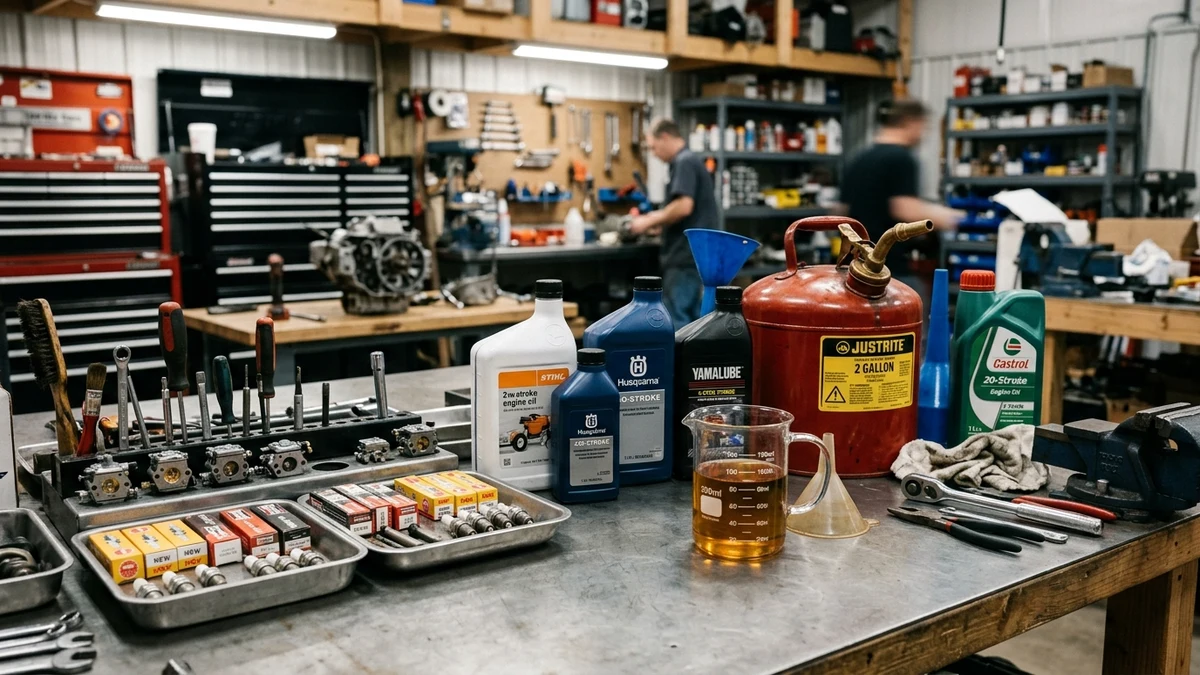
Comprehensive 2-Cycle Gas-to-Oil Ratio Master Chart
| Gasoline Volume | 50:1 Mix (Stihl/Echo) | 40:1 Mix (Craftsman/Ryobi) | 32:1 Mix (Lawn-Boy) | 16:1 Mix (Break-In) |
|---|---|---|---|---|
| 1.0 Gallon (128 oz) | 2.56 oz (76 mL) | 3.20 oz (95 mL) | 4.00 oz (118 mL) | 8.00 oz (237 mL) |
| 2.0 Gallons (256 oz) | 5.12 oz (151 mL) | 6.40 oz (189 mL) | 8.00 oz (237 mL) | 16.00 oz (473 mL) |
| 2.5 Gallons (320 oz) | 6.40 oz (189 mL) | 8.00 oz (237 mL) | 10.00 oz (296 mL) | 20.00 oz (591 mL) |
| 5.0 Gallons (640 oz) | 12.80 oz (379 mL) | 16.00 oz (473 mL) | 20.00 oz (591 mL) | 40.00 oz (1,183 mL) |
Fuel Quality, JASO FD Certification & Ethanol Traps
Modern two-stroke power equipment operates under strict emissions and heat parameters. When selecting oil, look for the JASO FD or ISO-L-EGD rating on the container label. These Japanese and international standards certify high lubricity and detergency with low ash formulation, preventing spark plug fouling and carbon exhaust port choking.
Additionally, commercial equipment operators should avoid ethanol-blended pump fuels whenever possible. Standard E10 gasoline contains 10% ethanol by volume, which is hygroscopic (attracts atmospheric water). Over 30 days of storage, water binds with ethanol and separates from the gasoline, settling to the bottom of the tank where fuel pickup lines ingest it. Always add 0.4 fl oz of fuel stabilizer per gallon if storing mixed fuel beyond two weeks.